

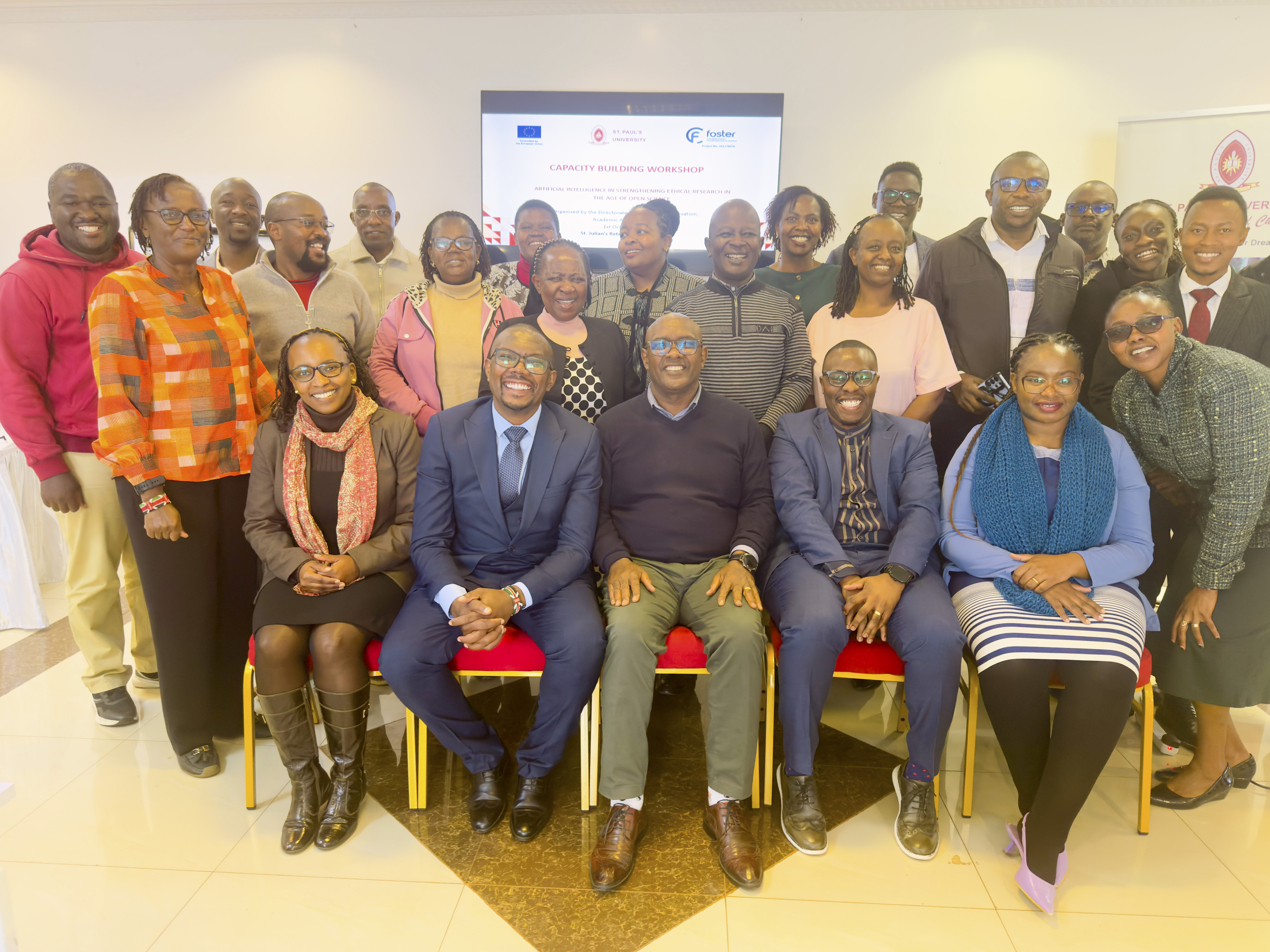
A capacity-building workshop convened by the Directorate of Research and Innovation equipped 27 participants to use artificial intelligence responsibly, strengthen research integrity and advance open science across the University.
St. Paul’s University held a capacity-building workshop on 1 October 2026 at St. Julian’s Retreat Centre under the theme “Artificial Intelligence in Strengthening Ethical Research in the Age of Open Science” supported through the FOSTER Project “Fostering digital transformation of science in Kenya and Tanzania” (Reference number 101178078), a three-year initiative co-funded by the European Union through the Erasmus+ Programme under the Capacity Building for Higher Education (CBHE) Action. The training brought together 27 members of the University’s research community, including Institutional Scientific and Ethics Review Committee members, School Research Coordinators, academic staff, and undergraduate and postgraduate supervisors.
Through expert presentations, practical demonstrations and group discussion, participants examined the opportunities and ethical challenges associated with AI in research. The programme addressed bias and fairness, transparency, data privacy, authorship and academic integrity, alongside responsible uses of AI for literature discovery, data processing, manuscript development, editing and grant preparation. A dedicated session on the FOSTER Open Science Framework connected these capabilities with open-science policy, curriculum integration, institutional support and citizen engagement.
Impact achieved
The workshop expanded the University’s internal capacity for informed and ethical engagement with AI by creating a shared foundation across research ethics oversight, research coordination and academic supervision. The 27 participants were exposed to practical approaches for assessing AI-related risks, protecting research participants and data, maintaining human accountability, and recognising appropriate and inappropriate uses of generative tools. The training also strengthened awareness of open, transparent and collaborative research practices and concluded with action planning to translate learning into academic and research workflows.
Institutionally, the initiative advances the Directorate of Research and Innovation’s mandate and supports the University’s Christian identity through stewardship, integrity, human dignity and academic excellence. It provides a basis for strengthening guidance for ethical review, supervision, research data management, responsible AI use and open dissemination, while encouraging interdisciplinary collaboration and innovation that responds to societal needs.
Connecting institutional action to policy
At national level, the workshop contributes to the Kenya Artificial Intelligence Strategy 2025–2030, particularly its emphasis on AI research and innovation, talent development, data governance, and ethics, equity and inclusion. By building the capabilities of researchers, supervisors and ethics-review personnel, the University is helping to develop the skilled and accountable research ecosystem required for locally relevant AI solutions in education and other priority sectors.
Regionally, the initiative aligns with the African Union Continental Artificial Intelligence Strategy and Agenda 2063 through an Africa-centred, development-oriented approach that seeks to harness AI’s benefits, build capabilities, minimise risks, stimulate investment and foster cooperation. It positions higher education institutions to generate context-responsive knowledge, strengthen African data and research capacity, and translate innovation into inclusive social and economic value.
Internationally, the workshop reflects UNESCO’s Recommendation on the Ethics of Artificial Intelligence, with its focus on human rights, dignity, transparency, fairness and human oversight, and the UNESCO Recommendation on Open Science, which promotes accessible, inclusive, transparent and collaborative research. Together, these frameworks reinforce the need to pair technological capability with ethical governance, equitable participation, research quality and public benefit.
Opportunities for higher education research and innovation
The convergence of responsible AI and open science creates significant opportunities for St. Paul’s University and the wider higher education sector. These include accelerating evidence synthesis and data analysis; developing locally relevant and multilingual AI solutions; improving research administration and grant development; strengthening reproducibility through responsible data and methods sharing; expanding interdisciplinary and cross-border collaboration; and widening public access to research and innovation. Realising these opportunities will require clear institutional guidance, appropriate infrastructure, continuous capacity building, ethical and data-protection safeguards, and recognition systems that reward open and responsible research practices.
The Directorate of Research and Innovation will build on the workshop by supporting policy development, curriculum integration, communities of practice and partnerships that move the University from awareness to responsible experimentation and measurable research impact. The engagement marks an important step towards a research culture in which AI augments—rather than replaces—human judgement, and open science strengthens the reach, credibility and societal value of scholarship.