RESEARCH DIRECTORATE
The Research Directorate seeks to build research capacity among scholars and contribute towards initiatives focused on society's sustainable development at large.
ABOUT THE DIRECTORATE
Research is perceived to be an invaluable asset in acquisition of knowledge among scholars not only for academic progression but also contribution towards society's development at large. In this regard, the Research Directorate was established to facilitate realization of the University's Mission: Develop Servant Leaders by Imparting Knowledge, Skills and Values through Creative Methods of Education, Research and Christian Spiritual Formation.
The Research Directorate seeks to build research capacity among scholars and contribute towards society's development at large. This is realised through:
Facilitation of research conferences, workshops and symposia in partnership with Government institutions, corporates and professionals in various fields.
Organizing publication of scholarly work in reputable journals.
Organizing of training sessions facilitated by experienced researchers.
Securing research grants for scholars.
To ensure relevancy, St. Paul’s University is guided by the university’s statutes, the Commission of University Education standards, the Sustainable Development Goals (SDGs), Kenya’s Visions 2023, African Union Agenda 2063, in addition to other international standards and frameworks such as open science. Our research agenda address the following cross-cutting thematic areas through multi-, inter- and cross-disciplinary lenses:
- Public & Community Health and Well-Being
- Environment, Climate Change and Resilience for Sustainable Development
- Ethical Systems and Technology for Sustainable Futures
- Leadership Integrity for Social Justice
Open science makes scientific research, data, software, and publications transparent, accessible, and reproducible for everyone.
Core Principles of Open Science
Transparency and Reproducibility: Research methods, code, and data must be clear and detailed enough for other scientists to verify and reproduce the results.
Open Access: Scientific publications and research findings should be available online for free, removing paywalls and subscription barriers.
FAIR Data Principles: Research data must be Findable, Accessible, Interoperable, and Reusable so both humans and machines can use it.
Open-Source Software and Materials: Tools, code, scripts, and hardware used in research should be shared openly with permissive licenses.
Open Peer Review: The review process should be collaborative and transparent rather than hidden behind closed doors.
Inclusivity and Equity: Scientific knowledge production should welcome diverse contributors, local communities, and global participants.
As Open as Possible, as Closed as Necessary: Data and results are shared openly by default, but can be kept private to protect personal privacy, security, or commercial/legal
Open Science at St. Paul’s University
Open Science is integrated in the university’s 2025-2030 strategic plan in several key areas:
Open Science policy – which provides the policy framework for the university
Open Access Journal – The university’s indexed and peer-reviewed Africa Multidisciplinary Journal which provides a space for African scholars to contribute to knowledge
Open Science Hub – which connects the university to community actors, co-designing projects around mental health, poverty reduction, Small and Medium Sized Enterprises (SMES) training, climate smart agriculture and use of Artificial Intelligence. The contemporary and open space is housed in the 2nd Floor of the Postgraduate Building and includes state-of-the-art infrastructure (smart boards, smart screens, foldable seats and chairs) and contemporary design that fosters creative collaboration
Curriculum – through a Master’s level course on “Open Science and Ethical Research” and informal courses open to the public through our learning management system
 Open Science Foster Project
St. Paul's University is participating in the FOSTER project from 2025-2027, titled "Fostering Digital Transformation of Science in Kenya and Tanzania" REF NO. 101178078 is a co-funded initiative by the European Commission (EU) addresses the Capacity Building in Higher Education (CBHE) action, which seeks to strengthen inclusive, collaborative and responsible Science, Technology, and Innovation ecosystems through the implementation of Open Science principles and values in Kenya and Tanzania Partner Countries (PCs), and is made up of 9 partnering universities and institutions.
See more here: https://spu.ac.ke/foster-project
St. Paul's University is a member of the Inter-University Sustainable Development Research Programme (IUSDRP), a consortium with membership drawn from Universities and Research Institutions in Europe, China, Africa and the United States of America, that undertakes research to advance sustainable development globally. The consortium organizes conferences and symposia annually that bring together reputable scholars, scientists and policy makers to address critical global sustainability challenges. These forums provide opportunities for mentoring postgraduate students who share their research, and receive feedback from renowned world-class scientists. The directorate has participated in Publication on Climate change courtesy of the consortium.
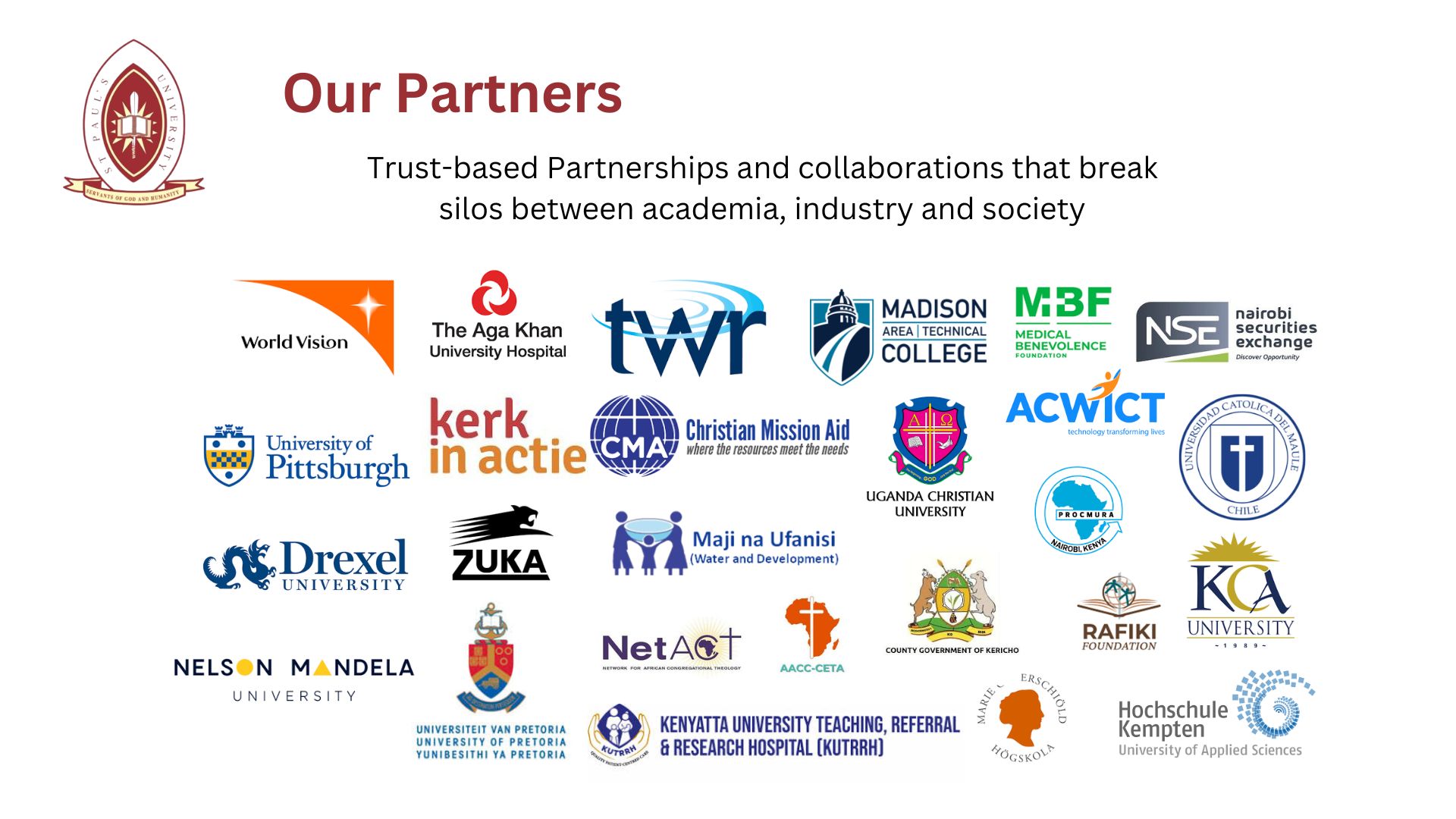
The directorate has also partnered with Annual American Association of Geographers (AAG, Ministry of Health of Kenya - Nursing Directorate, National Nursing Association of Kenya (NNAK, Nursing Council of Kenya (NCK, MBF’s Mary K Center for Global Nursing Development and the Christian Health Association of Kenya (CHAK); and is part of the National Nursing and Midwifery Research Panel (RAP).
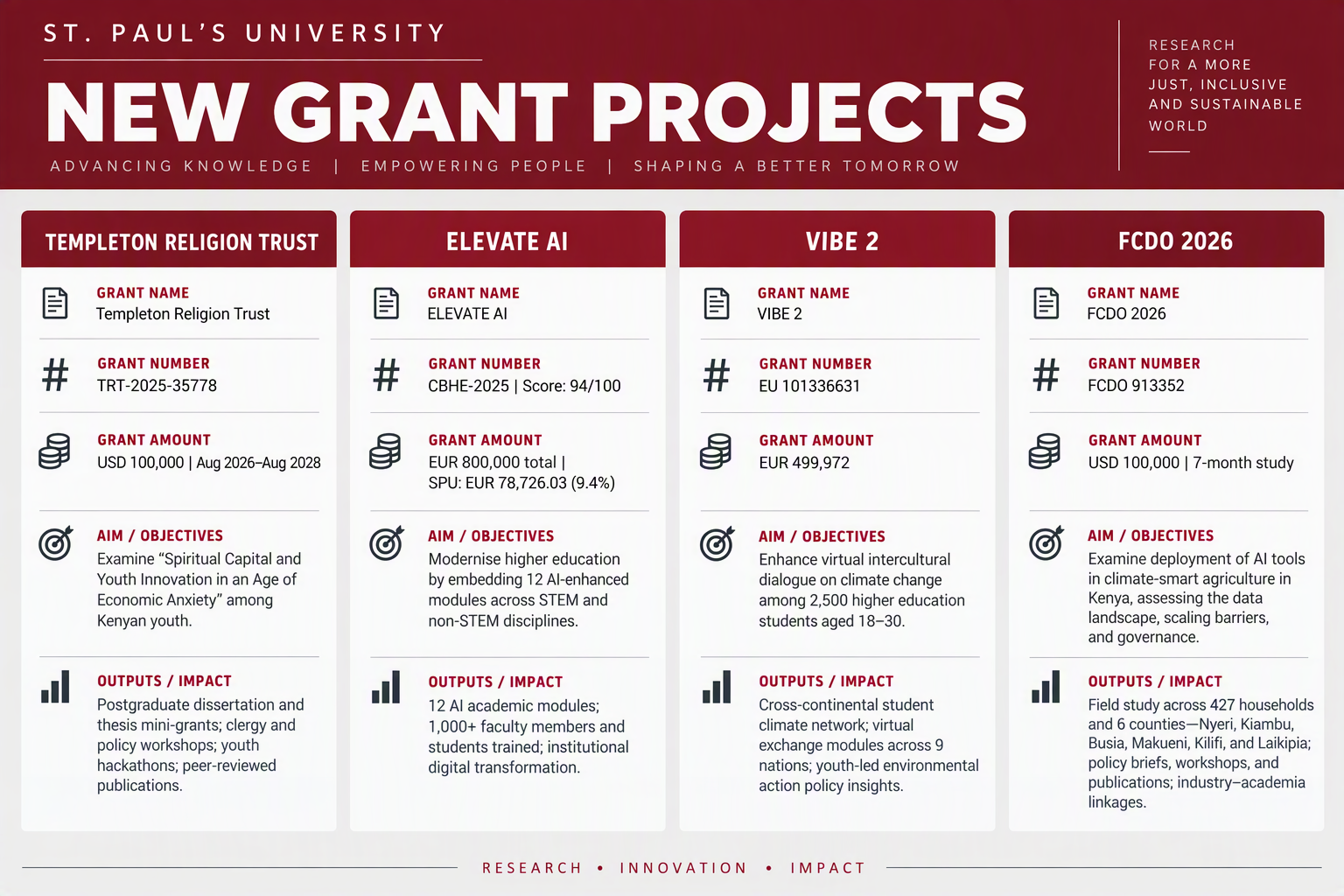
St. Paul’s University’s new grant portfolio advances interdisciplinary research and innovation across youth development, artificial intelligence, climate action, and climate-smart agriculture. Through international partnerships, academic capacity building, virtual exchange, field research, and policy engagement, the projects will equip students and faculty with practical skills while generating evidence to address pressing social and environmental challenges. Anticipated impacts include stronger institutional digital transformation, expanded youth-led innovation and climate networks, improved links between academia and industry, and actionable insights to inform policy and sustainable development.
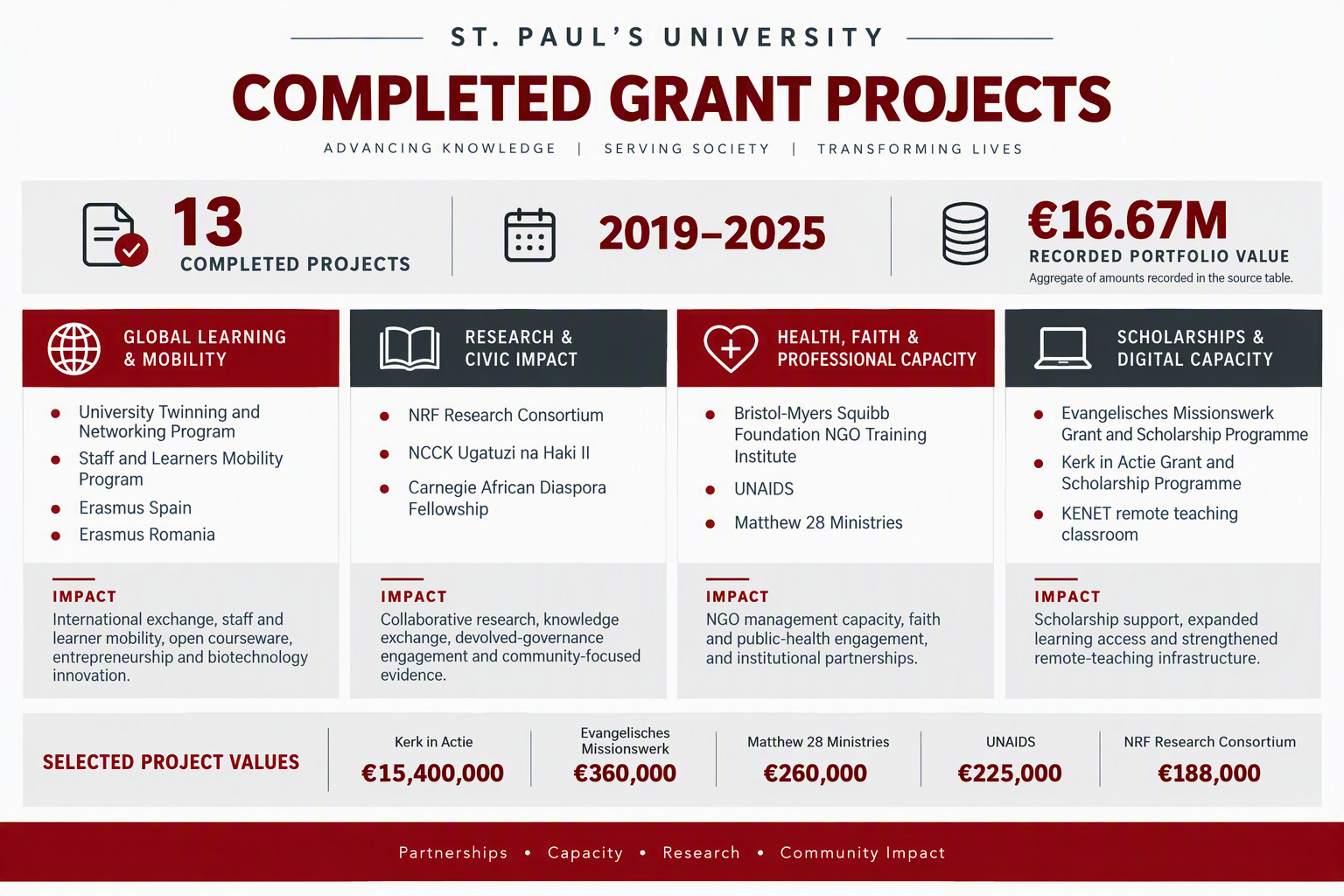
St. Paul’s University has completed 13 grant-supported projects spanning international mobility, collaborative research, civic engagement, health and faith initiatives, scholarships, and digital learning capacity. Delivered between 2019 and 2025, the portfolio represents approximately €16.67 million in recorded project funding and reflects sustained partnerships across universities, development organisations, foundations, and community institutions. Together, these initiatives strengthened institutional capacity, expanded access to learning and mobility, supported research and professional development, and generated practical benefits for communities and partner networks.