The Digital Reformation: Ethical AI in Theology
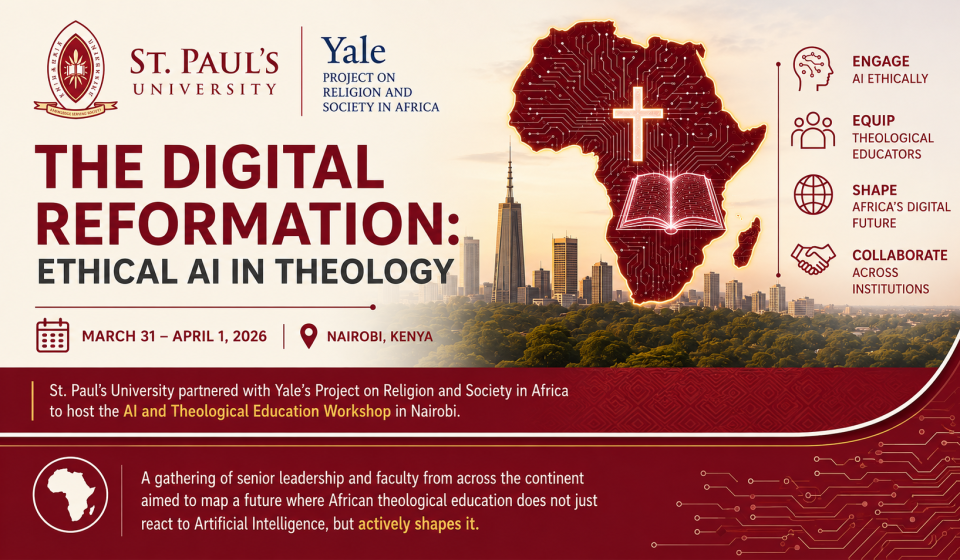
On March 31 and April 1, 2026, St. Paul’s University partnered with Yale’s Project on Religion and Society in Africa to host the AI and Theological Education Workshop in Nairobi. This gathering of senior leadership and faculty from across the continent aimed to map a future where African theological education does not just react to Artificial Intelligence, but actively shapes it.
The reach of AI is expansive, touching everything from everyday data analytics to the complex robotics of autonomous vehicles. For the purposes of theological education, we must recognize that these systems hold some form of decision-making power. They have become implementations of rational choice that now operate in spaces where human discernment was once the sole authority.
The program director of the Project on Religion and Society in Africa noted the current under-representation of African traditions and religious nuances in major AI models. He urged the academic community to actively shape the technology to make it a more fruitful tool for regional endeavors.
This sentiment was seconded by Rev. Julius Kithinji, Dean of the Joshua and Timothy School of Theology at St. Paul’s, who reminded participants to consider not just how AI contributes to theology, but how theology must contribute to and guide AI.
Technology and Theology
In the 16th century, the printing press sparked a reformation that changed how the world accessed God’s word. Today, we find ourselves at the precipice of a new era. However, unlike the tools of the past, AI is not a neutral transmitter of information; it is a “decision-machine” that interprets data based on the “corpus” it was trained on and the core beliefs of its developers. As such, human beings and AI do not share the same moral agency.
Furthermore, as people increasingly turn to AI for spiritual answers, religious institutions must scrutinize these technologies. The ethical stakes are high. For instance, the development of autonomous weapons systems pushes the boundaries of human control and intervention, raising urgent questions that only theological ethics can answer.
As born-again Christians, we are taught to seek truth. However, as we integrate AI into our theological studies, we must ask a critical question: Whose “truth” is the machine telling?
Artificial Intelligence and Secularism
One of the most profound insights from the workshop is that AI systems are not “worldview-neutral.” Most models are developed in secular, Western hubs that often default to Procedural Secularism. This means that AI models prioritize individual autonomy over deep theological reasoning and the communal spiritual nuances that define African Christianity.
The ethics of AI and robotics is particularly difficult, since it requires an understanding of normative ethics and metaethics, a grasp of the technologies themselves, and expertise in their vast areas of social impact.
When AI alignment focuses solely on “broad acceptability,” it often results in a systematic decline in performance regarding faith and spirituality. This creates a risk of Digital Catechesis, where our moral imagination is subtly reshaped by algorithms that do not know the Holy Spirit.
A Clarion Call
“Without a theological framework, we cannot properly inform policy, training, and implementation, or even the ethics of AI use.” — Martin Munyao, Daystar University
The workshop concluded with a call for SPU and its partners to move beyond being passive consumers of technology. Our role in this “Digital Reformation” involves:
- I. Bridging the “African Gap”: Actively shaping technology to ensure African traditions and religious nuances are represented in major AI models.
- II. Advocating for “Value-Sensitive AI”: Auditing and training models so they do not treat faith as a “hallucination.”
- III. Integrating Wisdom over Efficiency: Promoting a Biblical emphasis on wisdom to ensure technology serves the common good, rather than raw computing power.
- IV. Fostering Discernment: Equipping students to “test the spirits” and use AI for research (Logos) without replacing the relational revelation of the Spirit (Rhema).
Conclusion
The Reformation did not happen because of the machine; it happened because of the people who used the machine to seek God more deeply. At St. Paul’s University, we are committed to ensuring that theological education remains at the forefront of ethical innovation, guiding the next generation with an authentic African voice.
By thinking together and supporting one another, St. Paul’s University and its academic partners are ensuring that tertiary theological education remains ready to guide the next generation of leaders with integrity, vision, and a distinctively African voice.
Enquiries & Admissions
For further enquiries or to express an interest in our theology programs, kindly reach out to us through:
- Toll-Free Line: +254 800 723 000
- Email: contactcenter@spu.ac.ke
Saint Paul’s University | The University of Choice!